

There are literally 1000's of schematic symbols, and you should never expect to know them all. There are about 10 that you should memorize, and the rest you can look up.
Here we will show you some common schematic symbols and give a brief description of them. Some of them you may already know. We'll start with common devices that are easy to grasp.
Schematic Symbol for a Battery


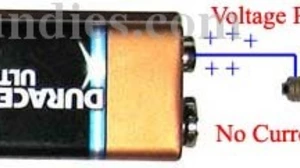
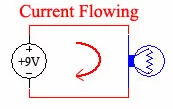
This is a battery. Notice that the + side has been designated on the schematic. This means that a battery is a polarized component.
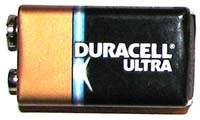
Make sure you observe the polarity of the battery when using it. On the actual image, the + terminal is the bottom of the two. It is smaller and labeled (not visible in photo) with a + sign on the side of the battery.
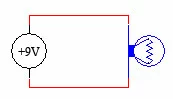
Schematic Symbol for a Light Bulb


Here we see a light bulb. A light bulb is not polarized, so you can hook it up with either terminal to either side of the battery. In the actual image the two places that you connect to the light bulb are the brass colored, threaded base and the silver colored tip at the very bottom.
Schematic Symbol for a Motor


This is the schematic symbol for a motor. Small electric motors tend to go one direction when hooked up one way, and the other direction when hooked up the opposite way. For this reason, they are considered polarized.
A small electric motor should work no matter which way you hook it up, and you may have to experiment to get the direction the way that you want it. Pictured is what is commonly called a "hobby motor". Hobby motors are small and cheap, and can usually be run off of very small batteries or even solar cells.
Schematic Symbol for a Buzzer


Here is what the schematic for a buzzer looks like. You can get small, mechanical buzzers at many electronics stores. They frequently are polarized and will not make any sound when hooked up in reverse.
Notice that the buzzer pictured has a red and a black wire. The red wire is positive (or V+), and the black wire is negative (or GND). This kind of buzzer makes a very loud whine when hooked up to any battery between +3 and +12 volts. It can be heard for probably half a mile.
Schematic Symbol for a LED


This is the schematic symbol for an LED, or Light Emitting Diode. You can pronounce LED as "el e dee". An LED is very similar to a light bulb, except it uses much less energy to make it light up.
The biggest difference between an LED and a light bulb is that an LED is polarized. This means it will only work if hooked up the correct way. This is covered in detail in the LED Guide.
Pictured are 3 clear LED's of different sizes. Notice that the LED legs have different lengths. The longer leg is the more positive side (+) and the shorter leg is the more negative (-) side.
In the schematic there is an arrow with a line on the tip. The tip of the arrow is the more negative side while the back of the arrow is the more positive side. Again, this is covered in more detail in the LED Guide.
Schematic Symbol for a Resistor


Here are is the schematic symbol for a resistor. Resistors are not polarized, so you can hook them up either way. This is evident in the schematic. Notice that both sides of the resistor are the same. There is no way to determine orientation from the schematic because it does not matter.
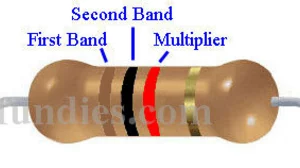
In the picture next to the schematic there are 3 different resistors to show that they have different colored bands on them. These colors help you to tell the resistors apart. We cover this in detail in the Resistor Guide.
Schematic Symbol for a Capacitor
Capacitors come in 2 varieties: polarized and non-polarized. You have to be sure that you know which kind you are dealing with when you use capacitors. We will talk about each of them separately. Capacitors are covered in detail in the Capacitor Guide. ÃÂ


Here is one possible schematic symbol for a capacitor. Next to the schematic are some ceramic capacitors. These are very common, cheap capacitors. They are called non-polarized capacitors, because there is not a + or - sign next to either of the legs. This is true for both the schematic symbol and the real life part. ÃÂ ÃÂ


This is the symbol for a polarized capacitor. In the picture next to the schematic we have some electrolytic capacitors. You may notice that the legs are marked with a (-) sign to indicate which side of the capacitor goes to GND.
Schematic Symbol for a Switch
Switches are used to provide human or real world input into your project. They come in many different varieties. Here we will only talk about the most basic kind. ÃÂ


This is a picture of a single pole switch. It has only 2 legs, and does not have a polarity. You can hook the switch up either way and it will work.
Schematic Symbol for a Transistors
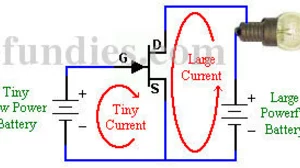
Transistors are little electronic switches. They always have 3 legs, and are always polarized. ÃÂ


Above is the schematic symbol for one type of transistor, and a few examples next to it. Understanding transistors takes a little bit of patience, but it is very important. They are the workhorse of most electronics projects.
When you are ready to learn more, check out our Transistor Guide where we describe how to identify which leg is which, and how to use transistors.